







GLOBAL CONFLICT, LOCAL HUNGER: THE ISRAEL–HAMAS WAR AND NIGERIA’S FOOD SECURITY CHALLENGE
How rising fertilizer costs, disrupted supply chains, and energy volatility are deepening Nigeria’s food insecurity.
Written by Gideon Iorgyer
Nigeria’s agricultural sector is once again confronting the indirect but significant consequences of global geopolitical instability. At a recent engagement under the Federal Ministry of Agriculture and Food Security (FMAFS), the Minister of Agriculture and Food Security, Senator Abubakar Kyari, expressed concern over how the ongoing Israel–Hamas conflict is affecting global fertilizer supply chains and, by extension, Nigeria’s food production system.
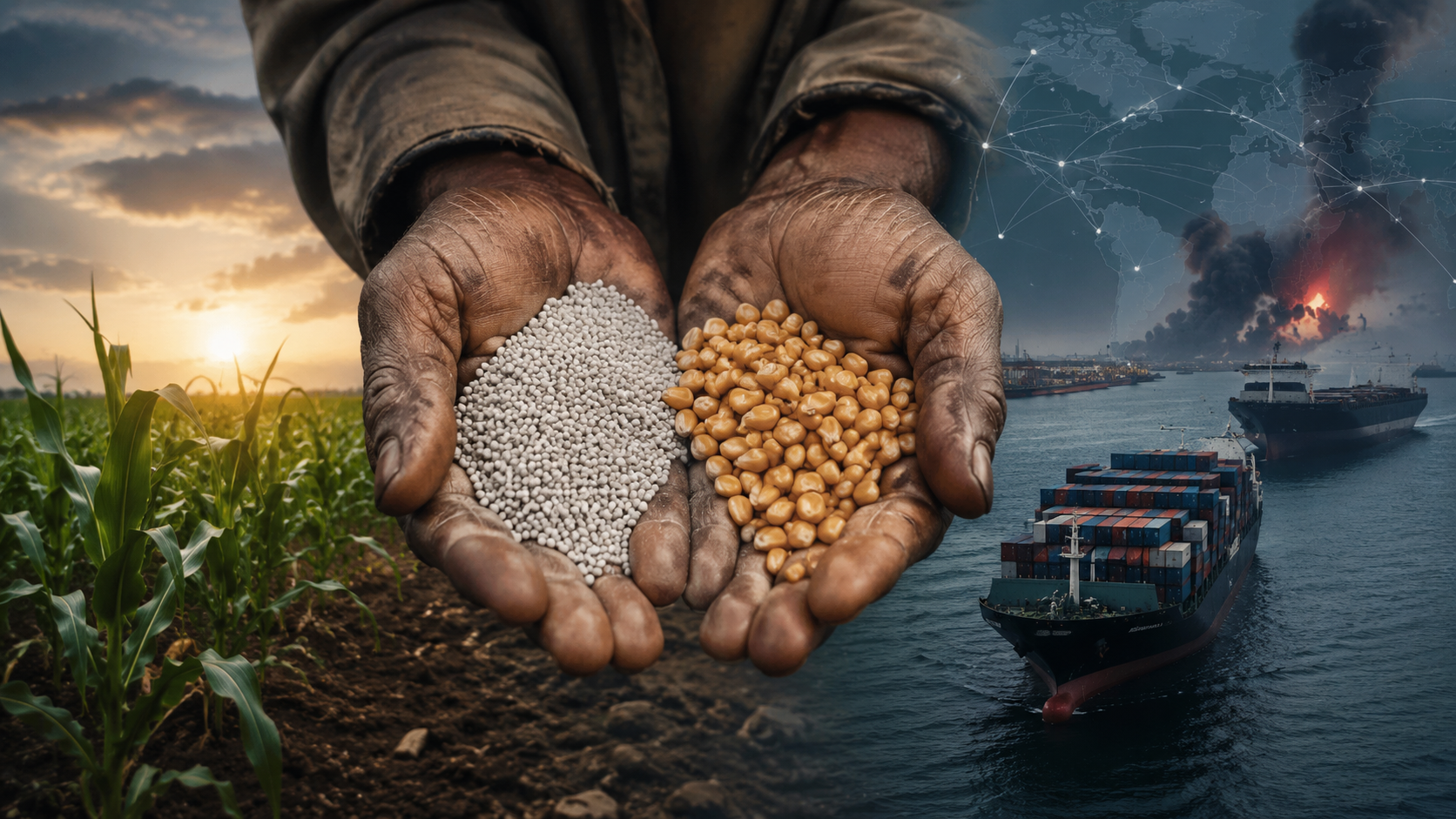
Although the war is geographically distant, its economic ripple effects are increasingly visible across Nigeria’s agricultural value chain. Fertilizer prices have risen globally due to disruptions in shipping logistics, higher energy costs, and instability in international trade routes linked to the broader Middle East crisis.
For Nigeria—already grappling with inflationary pressure, food insecurity, and foreign exchange constraints—these developments carry significant implications. Agriculture remains a major employer and a critical driver of rural livelihoods. However, the sector is highly exposed due to its dependence on imported agricultural inputs, particularly fertilizer components such as potash, phosphate, and ammonia derivatives.
This exposure highlights a structural vulnerability in Nigeria’s food production system: heavy reliance on global supply chains in a volatile geopolitical environment.
Why a Distant Conflict Matters to Nigerian Agriculture
To many Nigerians, the Israel–Hamas war appears remote and unrelated to domestic economic conditions. However, modern agriculture is deeply interconnected with global energy, logistics, and industrial supply systems.
Fertilizer production is closely tied to natural gas markets, international shipping networks, and stable trade corridors. When geopolitical tensions disrupt these systems, several cascading effects follow: shipping insurance increases, energy prices rise, export restrictions tighten, and supply chains slow down.
For Nigerian farmers, these disruptions translate into higher fertilizer costs. In turn, elevated input costs often lead to reduced fertilizer application, lower crop yields, tighter food supply, and ultimately higher food prices.
This dynamic affects agricultural producers across the country—from rice farmers in Kebbi, to maize farmers in Kaduna, and tomato growers in Benue—many of whom are far removed from the geopolitical epicenter but directly impacted by its economic consequences.
This is the new reality of globalization: local food systems are increasingly shaped by distant shocks.
Structural Weaknesses in Nigeria’s Agricultural Input System
The current situation reinforces long-standing concerns about Nigeria’s dependence on imported agricultural inputs. Fertilizer supply chains remain vulnerable due to reliance on external sources for key raw materials and finished products.
While Nigeria has made progress through initiatives such as the Presidential Fertilizer Initiative (PFI) and private-sector investments including the Dangote fertilizer complex, structural challenges persist—particularly around affordability, distribution efficiency, and last-mile access for small holder farmers.
Many farmers continue to face delays in fertilizer delivery and price volatility that limit productivity during critical planting seasons.
Without addressing these systemic issues, increases in domestic production capacity alone may not translate into improved food security outcomes.
Fertilizer, Food Security, and Systemic Risk
The ongoing global disruption underscores a broader structural risk: Nigeria’s agricultural productivity remains exposed to external shocks due to import dependence.
Key vulnerabilities include:
- Geopolitical exposure, where global conflicts affect availability and pricing of inputs.
- Foreign exchange constraints, which amplify import costs for agricultural inputs
- Logistics instability, which disrupts timely fertilizer delivery during planting seasons.
- Food security risk, where input shortages translate into reduced yields and higher food inflation.
Together, these factors create a system in which agricultural performance is tightly linked to external economic and political conditions.
The Underutilized Potential of Organic Fertilizer Systems
A critical but often underdeveloped dimension of Nigeria’s agricultural strategy is the limited scale of organic fertilizer systems.
Northern Nigeria, in particular, holds significant potential for compost-based fertilizers, livestock manure utilization, biofertilizer innovation, crop residue recycling, and agroecological farming systems.
However, these alternatives remain under exploited relative to their potential contribution to soil health and input cost stabilization.
A more balanced approach would integrate industrial fertilizer production with expanded organic systems, improved soil management practices, and climate-smart agriculture strategies.
Such diversification would reduce exposure to global price volatility while improving long-term soil productivity.
Policy Implications and Food Security Outlook
The current trajectory presents both a risk and an opportunity for Nigeria’s agricultural sector. On one hand, continued reliance on unstable global input markets increases vulnerability to price shocks and supply disruptions. On the other hand, it creates a strong case for accelerating domestic resilience strategies.
Priority areas include:
- Expansion of local fertilizer production capacity.
- Strengthening rural input distribution networks.
- Investment in organic and hybrid fertilizer systems.
- Improved access to agricultural finance for small holder farmers.
- Development of regional input supply partnerships within Africa.
Without targeted intervention, rising input costs could continue to suppress productivity and intensify food inflation pressures in the medium term.
Conclusion
The 2026 farming season may serve as a critical test of Nigeria’s agricultural resilience.
If structural interventions are not implemented—particularly in fertilizer supply stability, rural financing, and input accessibility—Nigeria risks deeper productivity challenges across its small holder farming systems.
The warning signs are already visible. The key question is whether policy responses will be reactive or transformative.

Post Comment